On Friday, July 26, 2013 I presented at the 2nd Twitter Math Camp. These are the slides from my presentation.
Monday, July 29, 2013

Monday, July 8, 2013
Keep the Date

I've been think about making a teacher's binder, but haven't quite nailed down what I want to go in it. I did know for sure that I wanted a smallish calendar to stick in the front pocket. I've tried the full paged three hole punched deal and it was too big and I didn't use it. I looked around a bit in my shopping travels and found nothing I liked, so I decided to make one myself.
 |
| Cover |
 |
| Inside |
It is just the right size; not too big, not too small. I made the cover in Photoshop Elements using digital scrapbooking paper from the Wheels on the Bus kit by Queen Wild Scrap. I made the inside in Excel. It covers from July 2013 through August of 2014. If you would like the file it is uploaded here. It is seven pages. The order will seem bizarre, but if you want to print your own follow these directions.
- 1. Print page one
- 2. Print page 2
- 3. Put page 2 back in the printer so that page 3 can be printed on the back, UPSIDE DOWN.
- 4. Repeat steps 2 & 3 for pages 4, 5 and 6, 7
- 5. Stack the pages with page 1 on the bottom blank side down/printed side up, page 2 face down on page 1, page 4 on page 3, and page 6 on top of page 5. Face up pages should seem right side up, with the face down pages upside down.
- 6. Put inside cover printed on thicker card stock paper. Fold the entire thing in half. Staple along the center seam.
Tuesday, July 2, 2013
TMC prep time!
After getting an email today from Lisa, it became a little more real that TMC13 is about three weeks away. I better get my act together!

I'm putting out a request for samples of tests and quizzes from any of you from any class. My intent is to share with folks ways to change assessments to make them more accessible to those kids with challenges. I think it would be valuable to show the essentials ideas with a variety of subjects and teacher styles.
Please send anything you are comfortable sharing to me, fourkatie, at my yahoo mail!
Thanks in advance!!!
Edited to add: I'm looking for anything and everything. They can be good, bad, or ugly. I can give you credit or black out your name. I'm just looking for authentic examples of quizzes and tests.
I'm putting out a request for samples of tests and quizzes from any of you from any class. My intent is to share with folks ways to change assessments to make them more accessible to those kids with challenges. I think it would be valuable to show the essentials ideas with a variety of subjects and teacher styles.
Please send anything you are comfortable sharing to me, fourkatie, at my yahoo mail!
Thanks in advance!!!
Edited to add: I'm looking for anything and everything. They can be good, bad, or ugly. I can give you credit or black out your name. I'm just looking for authentic examples of quizzes and tests.
Monday, July 1, 2013
Charged up!

I've got some made4math ideas floating around, but haven't gathered the supplies yet to attack any of them, but I did just set up a work area in my living room. I decided it was time to a have a work surface other than the nightstand next to my bed. My favorite part of this new work space is that I have set up a charging station for all of my devices (and those of my kiddos). I used this magazine rack from Ikea
 |
| Flata storage rack from Ikea |
 |
| Front View |
 |
| Side View |
So not exactly a #made4math, but a repurposed, organizational idea!
Thursday, October 18, 2012
GEMS!
I saw @jreulbach's foldable for order of operations and just loved the idea of using the mnemonic GEMS versus using PEMDAS.
To me it just seemed to point out that multiply and divide are on one level of the steps and subtract and add are on the same level. The fact that the mnemonic also has a visual shape that goes along with what your problem looks like when you show your work clearly is simply brilliant. I used to say your work should like an upside-down pyramid, but now I can say show your GEMS!
While I loved Julie's foldable, we have a binder system that I have to follow and resources etc. need to be 3-hole punched and put into the binder section for each class. So, I made a 2-sided resource for the students to add to their math section. So far it seems to be catching on. I had a student today tell me that they remembered to show their GEMS.
We'll call this a made4math even though it isn't Monday! If I waited until Monday, it may never have been blogged!
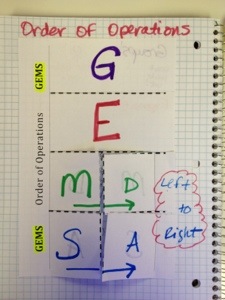 |
| Foldable from http://ispeakmath.files.wordpress.com/2012/09/20120918-102456.jpg |
To me it just seemed to point out that multiply and divide are on one level of the steps and subtract and add are on the same level. The fact that the mnemonic also has a visual shape that goes along with what your problem looks like when you show your work clearly is simply brilliant. I used to say your work should like an upside-down pyramid, but now I can say show your GEMS!
While I loved Julie's foldable, we have a binder system that I have to follow and resources etc. need to be 3-hole punched and put into the binder section for each class. So, I made a 2-sided resource for the students to add to their math section. So far it seems to be catching on. I had a student today tell me that they remembered to show their GEMS.
 |
| SIDE 1 of GEMS Resource |
 |
| SIDE 2 of GEMS Resource |
We'll call this a made4math even though it isn't Monday! If I waited until Monday, it may never have been blogged!
Tuesday, September 11, 2012
Grade/Age Equivalents are NOT numbers!
I'd like to share a pet peeve. While reviewing the intake materials on one of our new students, I came across his most recent triennial report in which the report was a canned summary from the Woodcock Johnson computer program (this is a whole other issue for me) and the test scores shared by the special educator were age and grade equivalents. I could not believe that the ONLY scores this special educator shared were the age and grade equivalents.
 |
| My soapbox. Except I wear cuter shoes! |
Why was this a problem for me?
Age and Grade Equivalents are NOT real numbers. They look like numbers, they sound like numbers, but they are not numbers. Please don't treat them like numbers. They are impostors.
What can an age or grade equivalent tell you about a student's performance? Not much. Say a student is in grade 8.2 (eighth grade, second month of school) and they earn a grade equivalent of 6.8 on the calculation test of the Woodcock Johnson III. This DOES NOT mean that this student is 1.4 grades behind in calculation. Why? Because they are not real numbers, so you can't do math with them like they are real numbers. All you know is that they earned the same number of corrects as the average student in the 6th grade, eighth month in the norm sample. Chances are that a 6.8 in calculation will fall within the average range for and eighth grader once you look at their percentile score or standardized testing scores.
Say this same student was tested last year and his calculation score was a grade equivalent of 4.2. Can I say that he made 2.6 grades of improvement in calculation? NO. Why? Because age/grade equivalents are NOT real numbers and should not be treated like numbers.
So why are they used? I think they are used because some people think that parents understand age/grade equivalents better than percentile or standard scores. I think that they offer a false sense of understanding and it is way more valuable to educate parents on standard scores. If you'd like scores that really are numbers and can be used to compare for progress purposes, use standard scores.
Repeat after me. "Age and grade equivalents are NOT real numbers."
*steps off soapbox*
Sunday, September 2, 2012
From a Distance
 |
| from http://wordandimage.wordpress.com/2010/01/10/literacy-visual/ |
"I cannot judge my work while I am doing it. I have to do as painters do, stand back and view it from a distance, but not too great a distance. How great? Guess."
I work with challenging students. All of my students have been identified with some sort of learning disability. I have students on the autistic spectrum, students with dyslexia, students with anxiety, students with language and writing disorders, students with ADHD, ODD, NVLD and a variety of other alphabet soup. In addition to whatever their particular labeled disorder my students, like all students, vary in their interest and motivation.
The beginning of every school year is much the same. Some time in late July or early August I find out what I will (probably) be teaching. I also get an idea of who might be in my classes. I start planning, usually in a vague, nonspecific way. I've learned not to get to invested in those ideas until the end of our training week when I can be slightly more certain of the what and who I'll be teaching. I over plan for the first week of classes, stressing myself out because I don't yet know the dynamic of my classes and it is always better to have more than not enough.
I can anticipate the cycle of the year. After the first couple weeks, I'll know my classes better. I'll be shocked at what they don't know. I'll be frustrated about what they didn't retain (especially those I taught last year), but I'll get in a groove and good things will start happening. The end of the first quarter will happen before I know it. I'll be disappointed because we are behind. I'll be frustrated because I know they can do more. I'll brainstorm new and different ways to attack their challenges. And I'll push them hard.
I'll blink and it will be Christmas. I'll be tired and grateful that it will be time for a break. I'll be a bit disgusted with the continuing struggles in my classes. I'll brainstorm new and different ways to motivate the couch potatoes and I'll try another way to attack those concepts that still elude us. We'll come back from break and I'll push them hard. We'll review and revise and practice and prepare. Then there will be midterm exams. I'll be pleasantly surprised at the improvement of some students and angry with myself for the confusion of others.
I'll brainstorm new and different ways to try to help them understand, to connect with the material, to become more independent students. And I'll push them hard. Sometimes they'll push back and tell me they hate math and tell me they can't do it. So I'll be gentle and push them hard with soft hands.
And this cycle will continue until we are somehow past the unending days in March, through another break and start in April, and have reached the end of May sliding into June. The whole way pushing hard and expecting more than they want to give sometimes. And I will catch myself still being disappointed that I couldn't do more, that it wasn't enough. Then will come the end of the year graduation and awards ceremony where we celebrate the achievements of each and every individual student.
Then I get the opportunity to step back. To remember where we were in late August and to see where we ended in June. Then I get to be amazed at how much we accomplished and how much was learned and how much my students grew as learners over the school year. And for the moment, I can appreciate the beauty in what I get to do each year.
And then I'll start brainstorming how I can do even better next year.
Subscribe to:
Posts (Atom)