Sunday, October 19, 2014
CT GAFE Summit 2014: Day 1
A couple of weeks ago @fouss put out a tweet asking if anyone was going to the GAFE Summit in Louisville. Having only recently figured out that GAFE stood for Google Apps for Education, I googled the GAFE Summit and was intrigued to find that there was one two weeks later at my alma mater, Manchester High School in Connecticut. I put in a request and was given funding to go to the conference.
So this weekend, I spent two days jamming information about all thing techy and Google. This post is attempt to download some stuff from my brain before I forget what I need to remember and take away from some excellent presentations.
Day 1: Keynote by James Sanders @jamestsanders
Very entertaining keynote. My favorite part had to do with the theme of failures and making mistakes. He shared a url for a site to share your teaching failure stories. I failed to write it down and have been unable to locate it.
Session 1: Beginners Guide to Admin Console by Peter Henrie
Very basics of setting up the structure of GAFE. I was relieved that some of the things I did but wasn't sure about turned out to be the right thing to do. I probably really needed to go to the next session he offered, but was trying to spread coverage of what I was seeing.
Session 2: Digital Portfolios with Kern Kelley @kernkelley
This was awesome. So much packed into this session on the process of getting work digitized and then developing digital portfolios. He provided great resources explaining his process. Digitized work all gets uploaded to Drive. Older students then create Google sites with self-selected artifacts to emphasize. I need to look through all he provided when I have some time. I think our school could really benefit from digital portfolios. I made lots of notes during this session that I hope will make sense when I look back at them.
Session 3: I had intended to go to the Chrome Support for Struggling Readers and Writers, but it was unfortunately canceled, so I went to another session by Peter Henrie on 10 ways to drive Google Apps adoption. A few takeaways here included Templates for your domain (turns out I didn't set this up, so our domain didn't have the ability to submit them. It does now). Positive use for Google Apps is using a calendar to manage resources that need to be signed out. Great general utility share was on the Chrome extension called One Tab - this is for when you have like 24 tabs open it will condense all the open tabs to a list that you can then share as a webpage. Also a recommendation to browse the edu section of the Chrome web store.
Session 4: Google Tools and Universal Design for Learning by Denise Jaffe @djaffe0660
A few notes here NewsEla has articles at differing lexile levels, Dogo News (I don't remember why I wrote this down). My favorite tip that I know I will use from this session was that in Sheets under Tools if you select research, you get a side bar on the right that you can do a search in without leaving your document and you can drag and drop images straight from this side bar into your doc and it will make a citation at the bottom of the page automatically.
Demo Slam
This was fun and energetic. Sadly, I did not win a Chromecast or a Chromebook.

Sunday, August 31, 2014
Baseline 3-2-1 Summary
This week in my middle school science class I gave my students a short article on scientific method and asked them to complete three tasks. The article was one page, highly structured and scores about grade 6.5 using the Flesch-Kincaid grade level formula

Three Tasks
1. Read the article2. Take notes
3. Answer 8 questions
Two Days
Students were give 70 minutes of class time split across two days.The purpose of this activity was to get a baseline on where they were starting from in terms of their ability to expository text independently.
Results (out of 7 students)
- Following directions is not a strength of this group. They needed a lot of verbal repetition of the three tasks (even with the list written on the board). One student did not take notes as part of his completion of the tasks.
- Out of 11 ideas I recorded on my notes, students identified between 3 and 7 of those ideas
- Only 1 student put a title on their notes
- 2 students had trouble putting notes in their own words and just copied long sentences of information
- Only one student completed a summary at the bottom of their notes (a la Cornell Notes)
- 1 student did not even start to answer the questions, he spun his wheels on day one unable to start the task. On day two, I cut the task in half and gave him a starting point and he was able to take notes.
- 1 student answered all 5 of the questions that could be found directly in the passage correctly, but was unable to correctly answer the 3 questions that require application or making connections.
- 1 student did not answer any of the direct questions correctly, but had great answers to the questions requiring application and connections.
- The other students fell in between those two extremes with mixed results.
One priority follow up
In class this week I will hand back their notes with feedback only (no grades) and we will develop a class resource of what is expected for notetaking. I will post a picture of this resource after it is developed.This 3-2-1 Summary is part of the weekly #MtbosChallenge

Sunday, August 24, 2014
3-2-1 Summary - week #2
3 - Days of Preservice Training
A lovely change this year was that instead of 5 days of preservice training, we only had 3. Of those 3 days of training, MORE THAN HALF of each day was set aside for prepping lessons and getting classrooms ready. It was awesome.
2 - Days of Weekend
I spent the weekend at the fair with my kids and my in-laws. It was grand fun, but I am tired and I did NO school work.
1 - First day of School
Tomorrow is the first day of school with the kids and I am so not ready. I did however get a kick out of my sons' reactions to the list of things I was gathering for tomorrow:
- every deck of cards we have in the house
- a hula hoop
- a ball of yarn
- a mason jar
- card stock
The deck of cards is for my Algebra 1 group, we are doing 31-derful tomorrow and the rest of the items are for some ice breakers I'm doing with the whole school (really, really small school). I'm looking forward to the start of the new year!
Monday, August 18, 2014
3-2-1 Resolutions
Sunday 3-2-1 Summary (on Monday)
I find as a teacher there are two New Year's Days, January 1st and the first day of school. So I find the beginning of the school year just as natural a time to make resolutions as the beginning of the calendar year. In some ways these resolution have a chance of being more successful as I'm relatively fresh coming off of summer and in the process of establishing the new routine of the school year.
3 ways I want to be better to myself
- Go to sleep at a reasonable time.
- Eat better while not depriving myself of small treats
- Exercise more
During the school year I find that I often put myself on the back burner. I'd like to prioritize myself and my health toward the top of this year's list.
2 ways I'd like to be better at my job
- Continue participating in #eduread, book chats, #spedmath chats
- Blog
I start the year off well, but then school and life takes over and I drop off the digital world. I am a better teacher when I'm engaging in great conversations and when I am engaged in self reflection.
1 way to make my home a better space
- Spend at least 15 minutes each day decluttering/cleaning
By June, my house often looks like a tornado has whipped through it. I try each year to start with a blank slate and a clean home, but I never really recovered this year. I find visual clutter overwhelming and right now I am overwhelmed in many rooms in my house. I'd like to make a small effort each day to make my home a more pleasant place to spend time.
I hope I am successful. The next step is to put structures and parameters into place to make these goals possible.
Do you have any New School Year Resolutions?
Sunday, August 17, 2014
First Five Days
Week #1 of the #MTBoSChalleng - My first 5 days plan for the 2014-2015 school year.

Day 1:
The first day is usually pretty much the same at my school. We start the day off with a whole school student meeting. We go over some important information and discuss what this year is going to look like. We address the really important things first including answers to the two questions our principal says the kids are worried about most: Where do I put my stuff? and When do I eat? So at this meeting we talk about the bell schedule and when lunch and snack breaks are. We also let them know when we will be assigning lockers. At this meeting the kids all introduce themselves, share a little something, and share their goal for the school year.
After the student meeting, we have a snack break and then get together in advisee groups for usually the rest of the morning. In advisee groups we get the kids set up and organized for the year. The school uses a standard binder organization for all students. We also have them date their agenda books and write in the period numbers and class names. This time is pretty easy-going and gives us time to chat with our new advisees about their summer and whatever else they feel compelled to share. Then we have lunch (although lunch is late this year so we may have a class before lunch).
After lunch we usually have one class. It looks like that will be my Algebra class. This is a 60 minute class and I anticipate that we'll have the whole time. Day 1 I am going to start with the normal routine. We will start with Estimation 180. Since some students had me last year and did Estimation 180 with me, this year we will start at Day 123.

Then we will complete a warm-up fashioned after Saxon Math's PowerUp. My kids will do a 1-minute fact practice timing followed by 5 questions that will review calculation problems or hit on IEP objectives that I will be measuring. Right now the categories look to be whole number operations, fractions, decimals, word problems, and basic algebra. As the year changes and IEPs get updated those categories will most likely change. I'm working on a form for this and will share when it is complete. Then I we'll do 31-derful as described over at Everybody is a Genius.

If they finish up they will start the cover for their Interactive Student Notebooks. Personalizing their covers is step one to their ownership. The covers will be a Numbers About Me activity. I'll either use this one or leave it more open-ended with this one I made last year.
We may have a second class, but that would be my plan period. After that we gather back in our advisee groups to complete any unfinished tasks. We also have a chart share where students share their progress (or work on) the fluency skill practice they completed over the summer. We dismiss a little early so that we can go over the dismissal procedures and so we can learn the kids' buses.
Days 2 - 5:
After day one we hit the ground running with a regular schedule. Here's my outline of what I think I'm going to be doing.

As discussed previously I'm going to use Q-bitz to start this metacognitive learning class. Day one students will play the solo style version in pairs. Day 2 we will review the 7 steps in the 7-step plan and begin analyzing the Q-bitz game using the plan. Focus on day two will be the first two steps: articulating the objective or task clearly and listing givens or known facts about the task. Days 3 and 4 we will discuss effective strategies for solving a card beginning with starting points and listing sequential steps to solve the task. Day 5 we will finish up with reflection on what we learned, developing a general rule from it and making bridges, or connections, from this task and what we learned to the world outside the classroom
General Science
Days 1 and 2 I am going to start with a demonstration to get the students to think about scientific method and observation. Plus it is fun to start with something cool. The demo uses milk, food coloring, and dish detergent. Here is a good explanation of the demo and above is a video of what it looks like. I've drafted a file for students to work with. I'm not quite satisfied yet. We will relate the scientific method to the 7-step plan they are already familiar with. Day 3 we are going to do a sort and categorize activity with different branches/types of science. I made cards with different field of science and the students are going to group them. This will give an opportunity to talk about some overarching qualities of science and to talk about some word parts/morphemes that will come up often (-ology, -ist, bio-, geo-, etc). Day 4 we will continue our vocabulary investigation with an introduction of some key terms for the first unit which will be about minerals. Day 5 I will introduce the SAFMEDS method for studying vocabulary. Since the focus at our school is building independent learners, teaching the strategies for getting meaning from words, mastering vocabulary, comprehending text, note taking, etc are just as important as "covering" content.
Decode
This is a remedial reading class using scripted curriculum from SRA Decoding. Looking over the IEPs for students in this class, I may have to integrate some spelling instruction here as well. We will hit the ground running in this class as they already know the routine.
Middle School Literature and Writing
Day 1 we will start by watching a Simon's Cat video. We will use it to complete as a class a Story Grammar Marker that will be used for the students to write a summary of the short video. This article at MindWing Concepts is where I got the idea. This class of three students (grades 7 & 8) are still struggling with decoding (they are at maybe 3rd/4th grade level). I thought introducing the elements of story grammar through a video would be less intimidating. This class is 75 minutes and I have a lot of thinking of how I want to break this class down. I have a general outline of where I'm going, but I need to see how they react and work before I can nail down an effective routing. Days 2- 5 will involve exploring the different aspects of the SGM through one or more Simon's Cat videos and then using those elements to write and edit a summary.
Algebra
Day one was described above. Days 2 - 4 will start with Est 180 and our warm-up and then will involve setting up Interactive Student Notebooks and some work with integers and integer operations. I think I also want to include Fawn's ark problem in during this first week. This will get nailed down a little more as I get into my office at school to select some materials and activities. I ordered new curriculum and can't wait for my CME Project Algebra 1 texts to come in. This class doesn't meet on Friday, so that gets me through the first week. Sadly, this class has gotten the least amount of thought so far because I'm the least worried about being competent to teach it!
So that is my #1st5days Plan for 2014-2015.
Monday, August 11, 2014
Productive Procrastination
I often procrastinate working on one thing by working on something else that needs work, but isn't as hard or challenging.
Today I went into school with the intent of doing some data entry on our reports system (like a student information system) and to do some looking into the Next Generation Science Standards so I can do some planning for my General Science class.
Task one was a success. I got overwhelmed with task 2. I went to National Science Teachers Association and I did print off the middle school standards, but then I felt overwhelmed and flooded.
And then my packages from Amazon arrived. Contents: Book of short stories for my lit/writing class, box of rocks and minerals, hardness collection test kit, Algebra Out Loud book, Swish card games, and Q-bitz.
I had my kids with me, so of course I broke out the Q-bitz and we started to play. This game requires you to recreate patterns from a game card using a set of 16 cubes. There are variations on how to play including racing to beat others, memory versions, and luck of the draw. We went noncompetitive and worked solo to recreate our own card patterns.
And that's when I decided that this game might be the exact right way to start my metacognition class this year. The group I have is a mix of year 2 and year 3 students, so they have covered different amounts of the FIE curriculum. This kind of analysis and visual manipulation is just the kind of abstract task that makes up the FIE curriculum. I think that I can use this game to review the basic 7-step plan we use for problem solving and introduce Cognitive Functions (thinking processes) in a low-entry way that won't repeat any of the instruments. This will put the two groups on an even playing field and unify the class so that I know where everyone stands before we start a new instrument together.
So, I was supposed to be planning for science, but instead I now have a solid plan to start another class. Productive Procrastination.
Today I went into school with the intent of doing some data entry on our reports system (like a student information system) and to do some looking into the Next Generation Science Standards so I can do some planning for my General Science class.
Task one was a success. I got overwhelmed with task 2. I went to National Science Teachers Association and I did print off the middle school standards, but then I felt overwhelmed and flooded.
And then my packages from Amazon arrived. Contents: Book of short stories for my lit/writing class, box of rocks and minerals, hardness collection test kit, Algebra Out Loud book, Swish card games, and Q-bitz.
I had my kids with me, so of course I broke out the Q-bitz and we started to play. This game requires you to recreate patterns from a game card using a set of 16 cubes. There are variations on how to play including racing to beat others, memory versions, and luck of the draw. We went noncompetitive and worked solo to recreate our own card patterns.
So, I was supposed to be planning for science, but instead I now have a solid plan to start another class. Productive Procrastination.
Sunday, August 10, 2014
Beginnings
It is the beginning of a new school year. The school where I work is a rather unique and amazing place. One of the things that makes it so special is that we start with the kids, their needs, and their IEPs and from those needs we develop a schedule. Because of this, what I teach can vary greatly from year to year. Some years I teach a lot of math. Others, not so much.
In addition to the variety of what I teach changing from year to year, the student make-up of the class changes the focus. So, even a class I've taught before may be radically different from year to year. I have remarkable freedom in my content classes to select what I cover and how I choose to cover it. While this is great, it can make classes outside my comfort zone challenging to plan for since there are no set requirements.
I'm trying to nail down my plan for the year, so I thought sharing it here might iron out some wrinkles.
So what does this year look like?
I start the day with a half hour of fluencies. Fluencies are 1-minute skill timings in reading, math, and typing. This period also serves as a morning homeroom of sorts. I'll have my 5 advisees for this group. I've had all these students in classes before.

First period is a metacognitive class called Instrumental Enrichment. It is a 45 minute class. We use the FIE curriculum and I've taught this class at some level for 15 years. This class has 10 kids and is a mix of year 2 and year 3 IE. They are a great mix of kids and I think we'll have some great discussions. I've got no worries about this class other than not repeating instruments that the year 3 guys have already done and going to fast for the year 2 guys. I think I'm going to start the year with Categorization and then go to Numerical Progressions. Then I'll think we'll swing back and finish the end of Organization of Dots. If you are interested in FIE, the folks at IRI have a nice overview document of the program.

Second period is a middle school General Science class. This is also 45 minutes. This class has 7 kids and is a mix of grades 6 through 9, but heavy on the grade 8s. I love science, but I don't teach it every year so this class is going to take a lot of my planning time. To start the year we are going to attack the general branches of science as a structural guide. I'm going to split the year in thirds, covering some earth science, some life sciences, and some physical science. Some of these kids haven't had much science background and I'd like to provide a foundation so that whatever science they have next year won't be completely foreign to them. I've selected 3 modules from the Jason Project to help structure our investigation. I need to become more familiar with the Next Generation Science Standards to make sure I'm not missing essentials for this class. I need to make sure that I plan regular hands-on experiments and demonstrations for this group. I'll be working on comprehension of expository text, note taking, and study skills. I'm nervous, but really excited about this class. I'm thinking of doing Interactive Student Notebooks with this class, but I'm not sure if I want to go composition book size or spiral notebook size. I have A LOT of work to do.
After second period students have a 15 minute snack break. Third period is 30 minutes and it is a planning period for me. I'll probably need to eat something this period since lunch is really late this year.

Fourth period is a remedial Decoding class. This is a 30 minute class. We use a scripted curriculum for this class from SRA. I've got 4 kids in this group and three of them were with me last year. Given that this is a scripted class, planning is straight forward for this class. I just hate correcting the workbook!

Period 5 is the class I'm most worried about. It is a 75 minute literature and writing class of 3 students. They are 7th and 8th graders. Optimistically, they decode at about a third grade level and their writing is equally challenged. I'll be working on narrative structure to start the year using the Story Grammar Marker from MindWing Concepts. I'm going to use the Simon's Cat videos to introduce the components of the SGM and use the organizer to have them write retellings of the stories. For the first quarter, we'll be reading short stories. I'll be introducing this group to Bookshare with the goal of helping them access more complex literature and novels as the year progresses. For writing I'll be using Co:Writer as an assistive technology application to help with their writing. I feel most out of my element in this class and still have a great deal to do to be ready.
After period 5 we have a 35 minute lunch. (This is 12:45 and I'm going to be hungry.)


Period 6 is Algebra 1. This 60 minute class has 5 students all of whom I've taught before. I'm definitely doing Interactive Student Notebooks with this group. I'm looking into adopting the CME Project Algebra 1 curriculum as the existing materials I have are either too simple for this group (Pacemaker) or way too overwhelming (Prentice Hall). I requested a sample and looking over the book, it seems to have nice visual and conceptual introduction to concepts and structurally it is organized with the topics and sequence that I end up rearranging other curricula. I will probably supplement with material from the Transitions to Algebra curriculum. I participated in the pilot and even was quoted in their brochure! I think the emphasis on mathematical habits of mind in both curricula will mesh well.
Period 7 is 45 minutes and my second planning period.
I end the day with a supported/structured study hall with the same 5 advisees that start the day with me. Here we work on organization, planning, study skills, and homework completion.
I still have a couple of weeks before school starts, but I have a lot of details to work out before then!
In addition to the variety of what I teach changing from year to year, the student make-up of the class changes the focus. So, even a class I've taught before may be radically different from year to year. I have remarkable freedom in my content classes to select what I cover and how I choose to cover it. While this is great, it can make classes outside my comfort zone challenging to plan for since there are no set requirements.
I'm trying to nail down my plan for the year, so I thought sharing it here might iron out some wrinkles.
So what does this year look like?
I start the day with a half hour of fluencies. Fluencies are 1-minute skill timings in reading, math, and typing. This period also serves as a morning homeroom of sorts. I'll have my 5 advisees for this group. I've had all these students in classes before.

First period is a metacognitive class called Instrumental Enrichment. It is a 45 minute class. We use the FIE curriculum and I've taught this class at some level for 15 years. This class has 10 kids and is a mix of year 2 and year 3 IE. They are a great mix of kids and I think we'll have some great discussions. I've got no worries about this class other than not repeating instruments that the year 3 guys have already done and going to fast for the year 2 guys. I think I'm going to start the year with Categorization and then go to Numerical Progressions. Then I'll think we'll swing back and finish the end of Organization of Dots. If you are interested in FIE, the folks at IRI have a nice overview document of the program.

Second period is a middle school General Science class. This is also 45 minutes. This class has 7 kids and is a mix of grades 6 through 9, but heavy on the grade 8s. I love science, but I don't teach it every year so this class is going to take a lot of my planning time. To start the year we are going to attack the general branches of science as a structural guide. I'm going to split the year in thirds, covering some earth science, some life sciences, and some physical science. Some of these kids haven't had much science background and I'd like to provide a foundation so that whatever science they have next year won't be completely foreign to them. I've selected 3 modules from the Jason Project to help structure our investigation. I need to become more familiar with the Next Generation Science Standards to make sure I'm not missing essentials for this class. I need to make sure that I plan regular hands-on experiments and demonstrations for this group. I'll be working on comprehension of expository text, note taking, and study skills. I'm nervous, but really excited about this class. I'm thinking of doing Interactive Student Notebooks with this class, but I'm not sure if I want to go composition book size or spiral notebook size. I have A LOT of work to do.
After second period students have a 15 minute snack break. Third period is 30 minutes and it is a planning period for me. I'll probably need to eat something this period since lunch is really late this year.

Fourth period is a remedial Decoding class. This is a 30 minute class. We use a scripted curriculum for this class from SRA. I've got 4 kids in this group and three of them were with me last year. Given that this is a scripted class, planning is straight forward for this class. I just hate correcting the workbook!
.jpg)
Period 5 is the class I'm most worried about. It is a 75 minute literature and writing class of 3 students. They are 7th and 8th graders. Optimistically, they decode at about a third grade level and their writing is equally challenged. I'll be working on narrative structure to start the year using the Story Grammar Marker from MindWing Concepts. I'm going to use the Simon's Cat videos to introduce the components of the SGM and use the organizer to have them write retellings of the stories. For the first quarter, we'll be reading short stories. I'll be introducing this group to Bookshare with the goal of helping them access more complex literature and novels as the year progresses. For writing I'll be using Co:Writer as an assistive technology application to help with their writing. I feel most out of my element in this class and still have a great deal to do to be ready.
After period 5 we have a 35 minute lunch. (This is 12:45 and I'm going to be hungry.)


Period 6 is Algebra 1. This 60 minute class has 5 students all of whom I've taught before. I'm definitely doing Interactive Student Notebooks with this group. I'm looking into adopting the CME Project Algebra 1 curriculum as the existing materials I have are either too simple for this group (Pacemaker) or way too overwhelming (Prentice Hall). I requested a sample and looking over the book, it seems to have nice visual and conceptual introduction to concepts and structurally it is organized with the topics and sequence that I end up rearranging other curricula. I will probably supplement with material from the Transitions to Algebra curriculum. I participated in the pilot and even was quoted in their brochure! I think the emphasis on mathematical habits of mind in both curricula will mesh well.
Period 7 is 45 minutes and my second planning period.
I end the day with a supported/structured study hall with the same 5 advisees that start the day with me. Here we work on organization, planning, study skills, and homework completion.
I still have a couple of weeks before school starts, but I have a lot of details to work out before then!
Sunday, August 4, 2013
Estimation
I should be working on setting up my interactive notebooks (INB) for classes, but that task seems overwhelming, so I procrastinated by thinking about my warm-up.
I have a 6th gradeish level math class first period. As a school for students with learning disabilities, many of whom have challenges in reading, there is an emphasis on improving reading. All first period classes complete a set of reading fluencies (timed, repeated readings) with their students. This occurs daily. I've not had math first period in a long time, and I needed to work out a way to get the reading done and then easily slide into more mathy-type topics.
I decided to use the Estimation 180 as a start of class activity. As students finish their readings (I think I'm going with paired student reading, with a rotation of one-on-one reads with me as there are an odd number of students in my class). The Estimation 180 of the day will be projected at the start of class, and as students finish up their reads they will complete their estimates. A great handout was posted recently on the site. I've modified that handout into a 2-per-sheet workspace to be pasted into a student composition book. This will be a separate notebook from the INB since my intention for the INB is for students to be creating their own "textbook". (More on this as I work out the details)
I originally was thinking about going with white boarding and just using the Estimation 180 recording form, but I really wanted a record of the students' work preserved so they could refer back to it. Using the composition book and form, students get the help of a structure to work with, but also to have the page opposite, page under, or even next few pages to use to work out their thinking. To give this the importance and room it need, as well as to give this a different emphasis from their INB, it needed to be in its own space.
I'd like to keep track of their ongoing accuracy with estimation, but I haven't decided on individual collection forms in their notebook (may create redundancy with recording data) or a group bulletin board where that is collected as we share. This may depend on the classroom space (not sure what room I'll be in for this class).
Edited to add:
I used the free Lexia Readable font on this form. It is available for download.
I have a 6th gradeish level math class first period. As a school for students with learning disabilities, many of whom have challenges in reading, there is an emphasis on improving reading. All first period classes complete a set of reading fluencies (timed, repeated readings) with their students. This occurs daily. I've not had math first period in a long time, and I needed to work out a way to get the reading done and then easily slide into more mathy-type topics.
I decided to use the Estimation 180 as a start of class activity. As students finish their readings (I think I'm going with paired student reading, with a rotation of one-on-one reads with me as there are an odd number of students in my class). The Estimation 180 of the day will be projected at the start of class, and as students finish up their reads they will complete their estimates. A great handout was posted recently on the site. I've modified that handout into a 2-per-sheet workspace to be pasted into a student composition book. This will be a separate notebook from the INB since my intention for the INB is for students to be creating their own "textbook". (More on this as I work out the details)
 |
| My worksheet. Click to download from box.net as .docx or as pdf |
I originally was thinking about going with white boarding and just using the Estimation 180 recording form, but I really wanted a record of the students' work preserved so they could refer back to it. Using the composition book and form, students get the help of a structure to work with, but also to have the page opposite, page under, or even next few pages to use to work out their thinking. To give this the importance and room it need, as well as to give this a different emphasis from their INB, it needed to be in its own space.
I'd like to keep track of their ongoing accuracy with estimation, but I haven't decided on individual collection forms in their notebook (may create redundancy with recording data) or a group bulletin board where that is collected as we share. This may depend on the classroom space (not sure what room I'll be in for this class).
Edited to add:
I used the free Lexia Readable font on this form. It is available for download.
Wednesday, July 31, 2013
#TMC13 - Exhaustingly Exhilirating
Last year I was a member of #twitterjealousycamp for sure. I wanted to go to St. Louis, but a combination of the cost and social insecurity deterred me.
With this year's TMC being in Philadelphia, a mere 5ish hour drive away, the cost became less of a deterrent and I volunteered to present so that I was committed to be at TMC in a tangible way. Apparently my sense of commitment is stronger than my social anxiety, and I found my way to Twitter Math Camp in Philadelphia.
I had quite a few fears about meeting up with a whole bunch of people I'd only ever interacted with online. Not safety fears, but social fears. My first fear was that nobody would attend my session. My second fear was that I would end up eating alone. My third fear was that I would end up hiding in my hotel room. My fears turned out to be unfounded and my experiences at #TMC13 were amazing.
My session went well (I think). Nine people came! @lmhenry9 live tweeted the session. She also got me to volunteer to do a repeat for #globalmath department on Sept 17th. She's very tricky like that.
I did not eat a single meal alone. I had great meals and even better company. And I only hid in my hotel room for short stretches just to decompress from the overwhelming amount of awesomeness.
A few of my TMC13 program highlights
- @fawnpnguyen and her problem solving sets at the middle school math session
- @maxmathforum and I notice... I wonder
- @trianglemancsd and 5 practices via tootsies and ootsies
- @borschtwithanna and @algebrainiac1 cooperative learning, especially passing the paper and everyone records their own ideas
- My favorites in general, but specifically @solvingforx - orangemallows, @jensilvermath - cool Lui Hui magnetic cubes, and @pamjwilson - the engagement wheel
While I came away from these days in Philly with some great content and classroom ideas, the more important take aways were the relationships. The people I met and interacted with were amazing; I can't even begin to say enough about just how awesome, how inviting, and how smart they all are. I came to TMC13 with fear and trepidation, but left with a new group of friends. It was hard to leave, but the best part is that I can visit with them ALL the time via twitter and their blogs and globalmath and google hangouts and and and...
Monday, July 29, 2013
#TMC13 Presentation
On Friday, July 26, 2013 I presented at the 2nd Twitter Math Camp. These are the slides from my presentation.
Monday, July 8, 2013
Keep the Date

I've been think about making a teacher's binder, but haven't quite nailed down what I want to go in it. I did know for sure that I wanted a smallish calendar to stick in the front pocket. I've tried the full paged three hole punched deal and it was too big and I didn't use it. I looked around a bit in my shopping travels and found nothing I liked, so I decided to make one myself.
 |
| Cover |
 |
| Inside |
It is just the right size; not too big, not too small. I made the cover in Photoshop Elements using digital scrapbooking paper from the Wheels on the Bus kit by Queen Wild Scrap. I made the inside in Excel. It covers from July 2013 through August of 2014. If you would like the file it is uploaded here. It is seven pages. The order will seem bizarre, but if you want to print your own follow these directions.
- 1. Print page one
- 2. Print page 2
- 3. Put page 2 back in the printer so that page 3 can be printed on the back, UPSIDE DOWN.
- 4. Repeat steps 2 & 3 for pages 4, 5 and 6, 7
- 5. Stack the pages with page 1 on the bottom blank side down/printed side up, page 2 face down on page 1, page 4 on page 3, and page 6 on top of page 5. Face up pages should seem right side up, with the face down pages upside down.
- 6. Put inside cover printed on thicker card stock paper. Fold the entire thing in half. Staple along the center seam.
Tuesday, July 2, 2013
TMC prep time!
After getting an email today from Lisa, it became a little more real that TMC13 is about three weeks away. I better get my act together!

I'm putting out a request for samples of tests and quizzes from any of you from any class. My intent is to share with folks ways to change assessments to make them more accessible to those kids with challenges. I think it would be valuable to show the essentials ideas with a variety of subjects and teacher styles.
Please send anything you are comfortable sharing to me, fourkatie, at my yahoo mail!
Thanks in advance!!!
Edited to add: I'm looking for anything and everything. They can be good, bad, or ugly. I can give you credit or black out your name. I'm just looking for authentic examples of quizzes and tests.
I'm putting out a request for samples of tests and quizzes from any of you from any class. My intent is to share with folks ways to change assessments to make them more accessible to those kids with challenges. I think it would be valuable to show the essentials ideas with a variety of subjects and teacher styles.
Please send anything you are comfortable sharing to me, fourkatie, at my yahoo mail!
Thanks in advance!!!
Edited to add: I'm looking for anything and everything. They can be good, bad, or ugly. I can give you credit or black out your name. I'm just looking for authentic examples of quizzes and tests.
Monday, July 1, 2013
Charged up!

I've got some made4math ideas floating around, but haven't gathered the supplies yet to attack any of them, but I did just set up a work area in my living room. I decided it was time to a have a work surface other than the nightstand next to my bed. My favorite part of this new work space is that I have set up a charging station for all of my devices (and those of my kiddos). I used this magazine rack from Ikea
 |
| Flata storage rack from Ikea |
 |
| Front View |
 |
| Side View |
So not exactly a #made4math, but a repurposed, organizational idea!
Thursday, October 18, 2012
GEMS!
I saw @jreulbach's foldable for order of operations and just loved the idea of using the mnemonic GEMS versus using PEMDAS.
To me it just seemed to point out that multiply and divide are on one level of the steps and subtract and add are on the same level. The fact that the mnemonic also has a visual shape that goes along with what your problem looks like when you show your work clearly is simply brilliant. I used to say your work should like an upside-down pyramid, but now I can say show your GEMS!
While I loved Julie's foldable, we have a binder system that I have to follow and resources etc. need to be 3-hole punched and put into the binder section for each class. So, I made a 2-sided resource for the students to add to their math section. So far it seems to be catching on. I had a student today tell me that they remembered to show their GEMS.
We'll call this a made4math even though it isn't Monday! If I waited until Monday, it may never have been blogged!
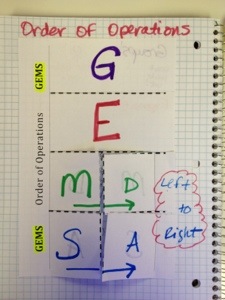 |
| Foldable from http://ispeakmath.files.wordpress.com/2012/09/20120918-102456.jpg |
To me it just seemed to point out that multiply and divide are on one level of the steps and subtract and add are on the same level. The fact that the mnemonic also has a visual shape that goes along with what your problem looks like when you show your work clearly is simply brilliant. I used to say your work should like an upside-down pyramid, but now I can say show your GEMS!
While I loved Julie's foldable, we have a binder system that I have to follow and resources etc. need to be 3-hole punched and put into the binder section for each class. So, I made a 2-sided resource for the students to add to their math section. So far it seems to be catching on. I had a student today tell me that they remembered to show their GEMS.
 |
| SIDE 1 of GEMS Resource |
 |
| SIDE 2 of GEMS Resource |
We'll call this a made4math even though it isn't Monday! If I waited until Monday, it may never have been blogged!
Tuesday, September 11, 2012
Grade/Age Equivalents are NOT numbers!
I'd like to share a pet peeve. While reviewing the intake materials on one of our new students, I came across his most recent triennial report in which the report was a canned summary from the Woodcock Johnson computer program (this is a whole other issue for me) and the test scores shared by the special educator were age and grade equivalents. I could not believe that the ONLY scores this special educator shared were the age and grade equivalents.
 |
| My soapbox. Except I wear cuter shoes! |
Why was this a problem for me?
Age and Grade Equivalents are NOT real numbers. They look like numbers, they sound like numbers, but they are not numbers. Please don't treat them like numbers. They are impostors.
What can an age or grade equivalent tell you about a student's performance? Not much. Say a student is in grade 8.2 (eighth grade, second month of school) and they earn a grade equivalent of 6.8 on the calculation test of the Woodcock Johnson III. This DOES NOT mean that this student is 1.4 grades behind in calculation. Why? Because they are not real numbers, so you can't do math with them like they are real numbers. All you know is that they earned the same number of corrects as the average student in the 6th grade, eighth month in the norm sample. Chances are that a 6.8 in calculation will fall within the average range for and eighth grader once you look at their percentile score or standardized testing scores.
Say this same student was tested last year and his calculation score was a grade equivalent of 4.2. Can I say that he made 2.6 grades of improvement in calculation? NO. Why? Because age/grade equivalents are NOT real numbers and should not be treated like numbers.
So why are they used? I think they are used because some people think that parents understand age/grade equivalents better than percentile or standard scores. I think that they offer a false sense of understanding and it is way more valuable to educate parents on standard scores. If you'd like scores that really are numbers and can be used to compare for progress purposes, use standard scores.
Repeat after me. "Age and grade equivalents are NOT real numbers."
*steps off soapbox*
Sunday, September 2, 2012
From a Distance
 |
| from http://wordandimage.wordpress.com/2010/01/10/literacy-visual/ |
"I cannot judge my work while I am doing it. I have to do as painters do, stand back and view it from a distance, but not too great a distance. How great? Guess."
I work with challenging students. All of my students have been identified with some sort of learning disability. I have students on the autistic spectrum, students with dyslexia, students with anxiety, students with language and writing disorders, students with ADHD, ODD, NVLD and a variety of other alphabet soup. In addition to whatever their particular labeled disorder my students, like all students, vary in their interest and motivation.
The beginning of every school year is much the same. Some time in late July or early August I find out what I will (probably) be teaching. I also get an idea of who might be in my classes. I start planning, usually in a vague, nonspecific way. I've learned not to get to invested in those ideas until the end of our training week when I can be slightly more certain of the what and who I'll be teaching. I over plan for the first week of classes, stressing myself out because I don't yet know the dynamic of my classes and it is always better to have more than not enough.
I can anticipate the cycle of the year. After the first couple weeks, I'll know my classes better. I'll be shocked at what they don't know. I'll be frustrated about what they didn't retain (especially those I taught last year), but I'll get in a groove and good things will start happening. The end of the first quarter will happen before I know it. I'll be disappointed because we are behind. I'll be frustrated because I know they can do more. I'll brainstorm new and different ways to attack their challenges. And I'll push them hard.
I'll blink and it will be Christmas. I'll be tired and grateful that it will be time for a break. I'll be a bit disgusted with the continuing struggles in my classes. I'll brainstorm new and different ways to motivate the couch potatoes and I'll try another way to attack those concepts that still elude us. We'll come back from break and I'll push them hard. We'll review and revise and practice and prepare. Then there will be midterm exams. I'll be pleasantly surprised at the improvement of some students and angry with myself for the confusion of others.
I'll brainstorm new and different ways to try to help them understand, to connect with the material, to become more independent students. And I'll push them hard. Sometimes they'll push back and tell me they hate math and tell me they can't do it. So I'll be gentle and push them hard with soft hands.
And this cycle will continue until we are somehow past the unending days in March, through another break and start in April, and have reached the end of May sliding into June. The whole way pushing hard and expecting more than they want to give sometimes. And I will catch myself still being disappointed that I couldn't do more, that it wasn't enough. Then will come the end of the year graduation and awards ceremony where we celebrate the achievements of each and every individual student.
Then I get the opportunity to step back. To remember where we were in late August and to see where we ended in June. Then I get to be amazed at how much we accomplished and how much was learned and how much my students grew as learners over the school year. And for the moment, I can appreciate the beauty in what I get to do each year.
And then I'll start brainstorming how I can do even better next year.
Monday, August 27, 2012
I do not think this means what you think it means...
Going into my 15th year as a teacher in my present school, I have participated in many, many professional development sessions. We have 5 days before each school year, 2 full days during the year, and an hour and a half every single Friday. While I can't say that every one has been essential, meaningful, and valuable to me, I can say that for the most part as a participant I feel my school's PD generally has the best of intentions to be purposeful and relevant to the school's needs and the needs of its students.
Tuesday's afternoon session was an exception. This session was as out of place and as wanted as okra in the Northeast. On our schedule it indicated that the topic of the session was on Bullying (awareness and prevention - not how to be a better one). The presenter was from the outside world (i.e. not my school). This generally perks everyone up as novelty is preferable to the same typical voices that present our PD (mine include).
I was almost immediately confused. I really couldn't tell how the presenter was going to work from his introduction into bullying awareness and prevention. Well, he didn't. He never touched on it. The presentation turned out to be on peer-led conflict resolution. After a half hour my brain finally shifted out of "this is supposed to be about bullying prevention" and opened to actually listen about what was being presented. While in theory much of what was presented seems like it might work in a larger, public school setting I really couldn't see how this process could work with the systems we already had in place and with the language/cognitive challenges of our students.
The one bright spot in the training was the playing roles of students from (actual) scenarios we had contributed. My favorites included:
I'm thinking I probably will not find and everyday use for this particular training, but I did come out with a few labels/terms that may help me articulate some problem solving in the future. My favorite term was in the materials on what escalates conflict. Conflict archaeology is when a student throws in stuff that happened from the dawn of time causing an increase in the complexity of the current conflict. This often derails productive conversation because they are no longer discussing the present issue. I have been victim to this.
Maybe our presenter doesn't know what Bullying Awareness means. Or maybe some lines got crossed and he misunderstood what he was asked to present. Either way, I'm thinking we will be having some professional development on Bullying Prevention and Awareness as this is a state required topic to be addressed yearly. Perhaps it will be the same day we review procedures for blood-born pathogens.
Tuesday's afternoon session was an exception. This session was as out of place and as wanted as okra in the Northeast. On our schedule it indicated that the topic of the session was on Bullying (awareness and prevention - not how to be a better one). The presenter was from the outside world (i.e. not my school). This generally perks everyone up as novelty is preferable to the same typical voices that present our PD (mine include).
I was almost immediately confused. I really couldn't tell how the presenter was going to work from his introduction into bullying awareness and prevention. Well, he didn't. He never touched on it. The presentation turned out to be on peer-led conflict resolution. After a half hour my brain finally shifted out of "this is supposed to be about bullying prevention" and opened to actually listen about what was being presented. While in theory much of what was presented seems like it might work in a larger, public school setting I really couldn't see how this process could work with the systems we already had in place and with the language/cognitive challenges of our students.
The one bright spot in the training was the playing roles of students from (actual) scenarios we had contributed. My favorites included:
- the poorly received assistance from an avuncular upper clansman and resulting hurt feelings
- the vainglorious drama-seeking-center-of-attention-hogging-mean-girls and their rotating exclusion of each other
- explosive-red-head and his paranoid response to what he thought was name calling, but turned out to be an unrelated discussion about an orangutan and his red butt
And the best
- Hemmingway-esque student with economic use of words and understated style of speaking tries to help low-energy-work-avoidant student take responsibility for his actions. This particular scenario caused our outside presenter to become so frustrated with the lack of resolution being brought about that he declared "this kid needs help desperately" and the entire role playing group laughed and said "ya think?"
I'm thinking I probably will not find and everyday use for this particular training, but I did come out with a few labels/terms that may help me articulate some problem solving in the future. My favorite term was in the materials on what escalates conflict. Conflict archaeology is when a student throws in stuff that happened from the dawn of time causing an increase in the complexity of the current conflict. This often derails productive conversation because they are no longer discussing the present issue. I have been victim to this.
Maybe our presenter doesn't know what Bullying Awareness means. Or maybe some lines got crossed and he misunderstood what he was asked to present. Either way, I'm thinking we will be having some professional development on Bullying Prevention and Awareness as this is a state required topic to be addressed yearly. Perhaps it will be the same day we review procedures for blood-born pathogens.
Tuesday, August 21, 2012
What's in a name?
New Blogger Initiative
A group of experienced folks in mathmagic land decided that it would be awesome-sauce to help kickstart others into the world of blogging and put out a challenge. I responded to that challenge committed to the new blogger initiative to help get me on the road. Each week for four weeks newbs like me will respond to a prompt (or prompts) emailed to them.This week the prompt I picked was: Where does the name of your blog originate? Why did you choose that?(Bonus follow up: Why did you decide to blog?)
I originally set up my blog last summer (2011), but as I generally feel more comfortable keeping myself to myself, I really never got up the gusto to actually put anything out there. My original intention was to use my blog like a personal journal of sorts to help reflect upon what was happening in my classroom. I thought that by documenting what was or wasn't working in my classroom, I would be able to improve upon my practice. Also, I felt that the act of writing (typing) things out might help to clarify my thinking.
 |
| image from http://studentweb.wilkes.edu/jennifer.werner/FinalProjectWerner/reflections.html |
With the intention of the blog really meant for personal reflection, I wanted a name that incorporated that idea and was mathy as well. The blog is like looking in the mirror at myself and looking at the reflection with a critical eye. This idea made me think about axes of reflection in geometry. And so a blog was born and named.
And that was all the blog was for a loooooonnnnnggg time. It wasn't until Made 4 Math Monday that I actually put anything into the blog. I felt that I had been lurking and reading and benefiting from the marvelous mathtwitterblogosphere and that perhaps it was time to contribute something back to that community.
Monday, August 6, 2012
Magazine holders and Binder Clip Labels
It's been a very busy week. Along with some changes in my job and some new job titles I have a new office. I will be coordinating all the testing of students and of course all the testing materials. I inherited a crazy mess and with the help of Pinterest (here and here) have tidied it up.
 |
| Before |
It did not occur to me to take a before picture until I had emptied most of the shelves, but these two shelves are pretty representative of what was there.
 |
| After |
The top two shelves were organized using magazine holders from Ikea. At 5 for $1.99 they were a steal. I made labels in Photoshop elements using digital scrapbooking paper. I love the coordinating, uniform look of them!
 |
| Labeled |
Underneath I organized materials using a Fellowes literature organizer. Each cubby is labeled with a binder clips. We use alternating forms for many tests, so year 1 is green and the alternating year is blue. Tests without alternate forms have black binder clips. I used Avery 5366 file folder labels and modified the word template so that they were only 1.25 inches wide (the width of the binder clips) and then I trimmed them with scissors.
In addition to the clearing of the shelf, I've also cleared out and organized a file cabinet full of stuff. It feels much better now that everything is organized!
Edited to add: The other great thing about using the binder clips is that the last copy of any form is clipped to the shelf so that no one can claim they "accidentally" took the last one.
Edited to add: The other great thing about using the binder clips is that the last copy of any form is clipped to the shelf so that no one can claim they "accidentally" took the last one.
Monday, July 30, 2012
Made 4 Math - Digi-Organization
I finally found out my schedule for this coming school year. It is more special educationish and less mathish than my schedule has been the last few years. But with that information in hand, I was able start getting my stuff organized for the upcoming year.
Each year the school provides a planner/gradebook like this:

I attempted to use it years ago, but it did not work for me. I've made paper templates for a planner and used them with limited success. I thought about developing a database in Access to manage these things, but it was too much and I gave up. I tried out Planbook software, but it was just too much stuff and not quite what I wanted. I have been using an excel spreadsheet for my gradebook and I've mostly liked it.
For this week's Made 4 Math Monday I decided that what I really want is for my planner and gradebook and all my notes and organizational thinking to be put together in one place and the only way to make that happen was to make it myself. Enter Bento. Bento is a super simple database program. It is not a relational database, so it is limited in what is can do. I like that it is simple and that it has iPhone and iPad versions. I'm thinking if this works successfully I will probably buy those and work out how to have the data sync/share appropriately. I downloaded the free trial of Bento, but will have to pony up the purchase price should I actually implement this as my trial period expires before school starts. So far I like and dislike the simplicity of the program, but think I might find it useful.
I have done some preliminary work and here are some screenshots of what I have so far.
We have an 8 period day (plus a period for lunch). My planner form has space for all my classes (some periods I teach two different courses) and room to jot down plans/meetings/to dos for my preparation periods. Sizes were adjusted for the typical amount of space I figure I'll need to jot down the overview of what I plan on doing. Preparation periods are slimmer, content classes beefier. I've created records for each day of the year and included important calendar information in the notes section.
My school requires us to complete a long-range plan for each quarter to submit to the principal so that she knows generally what each class should be doing should a parent or LEA (Local Education Agency) call to enquire about what a particular kiddo is working on. This form provides a space to generally describe what will happen each week in the first quarter in a class. I've already created a record for each class I'll be teaching.
Each year the school provides a planner/gradebook like this:

I attempted to use it years ago, but it did not work for me. I've made paper templates for a planner and used them with limited success. I thought about developing a database in Access to manage these things, but it was too much and I gave up. I tried out Planbook software, but it was just too much stuff and not quite what I wanted. I have been using an excel spreadsheet for my gradebook and I've mostly liked it.
For this week's Made 4 Math Monday I decided that what I really want is for my planner and gradebook and all my notes and organizational thinking to be put together in one place and the only way to make that happen was to make it myself. Enter Bento. Bento is a super simple database program. It is not a relational database, so it is limited in what is can do. I like that it is simple and that it has iPhone and iPad versions. I'm thinking if this works successfully I will probably buy those and work out how to have the data sync/share appropriately. I downloaded the free trial of Bento, but will have to pony up the purchase price should I actually implement this as my trial period expires before school starts. So far I like and dislike the simplicity of the program, but think I might find it useful.
I have done some preliminary work and here are some screenshots of what I have so far.
 |
| Launchpad |
My launch-off point is the view of all the tables I created and put in the 2012-2013 School Year folder.
 |
| Daily Planner |
We have an 8 period day (plus a period for lunch). My planner form has space for all my classes (some periods I teach two different courses) and room to jot down plans/meetings/to dos for my preparation periods. Sizes were adjusted for the typical amount of space I figure I'll need to jot down the overview of what I plan on doing. Preparation periods are slimmer, content classes beefier. I've created records for each day of the year and included important calendar information in the notes section.
 |
| Quarter Long Range Planner |
My school requires us to complete a long-range plan for each quarter to submit to the principal so that she knows generally what each class should be doing should a parent or LEA (Local Education Agency) call to enquire about what a particular kiddo is working on. This form provides a space to generally describe what will happen each week in the first quarter in a class. I've already created a record for each class I'll be teaching.
 |
| Daily Notes |
I'm not sure how useful this particular form will be, but I wanted a place to record random tidbits, things to remember, and notes to myself. I have a feeling this will go by the wayside once I get overwhelmed, but I'm going to give it a try.
As a special educator, I need to keep data on student progress on their IEP goals and objectives. This form gives me a space to record objectives and data each quarter. I have a feeling that I'll need to enlarge the data boxes as time progresses, but for now the arrangement felt pleasing to my eye.
I am least satisfied with my Gradebook template. This is where some of the limitations of Bento are annoying me. It limits in the spacing of the cells and limits in the types of calculations it performs. Also, since it is not a relational database I can't have it automatically take values from one table to be used in another. For each assignment, a student receives an initial grade. It is my school's policy that students fix or error repair grades that show poor understanding or poor quality work (less than 80 percent generally). During the first quarter I average their initial score with their improved score. This average is the grade that counts. On a positive, I can export the data to excel, so if I hate it and it is unmanageable, I can always revert to the excel gradebook I have used in the past. I'm giving this a go because I really want one central place to keep all my data.
I don't know if any of this is helpful to anyone else as one of the major reasons I've created it is that the many unique quirks of my particular school make using others' stuff unwieldy. We have an eight period day, my largest class is 9 students this year, I teach two classes some periods, and I have job responsibilities outside of my teaching that I need to keep track of. All of this compelled me to customize. I'm hoping it will work for me!
 |
| Objective Data |
As a special educator, I need to keep data on student progress on their IEP goals and objectives. This form gives me a space to record objectives and data each quarter. I have a feeling that I'll need to enlarge the data boxes as time progresses, but for now the arrangement felt pleasing to my eye.
 |
| Gradebook |
I am least satisfied with my Gradebook template. This is where some of the limitations of Bento are annoying me. It limits in the spacing of the cells and limits in the types of calculations it performs. Also, since it is not a relational database I can't have it automatically take values from one table to be used in another. For each assignment, a student receives an initial grade. It is my school's policy that students fix or error repair grades that show poor understanding or poor quality work (less than 80 percent generally). During the first quarter I average their initial score with their improved score. This average is the grade that counts. On a positive, I can export the data to excel, so if I hate it and it is unmanageable, I can always revert to the excel gradebook I have used in the past. I'm giving this a go because I really want one central place to keep all my data.
I don't know if any of this is helpful to anyone else as one of the major reasons I've created it is that the many unique quirks of my particular school make using others' stuff unwieldy. We have an eight period day, my largest class is 9 students this year, I teach two classes some periods, and I have job responsibilities outside of my teaching that I need to keep track of. All of this compelled me to customize. I'm hoping it will work for me!
Subscribe to:
Posts (Atom)